

Real Assets
We build future energy systems and resilient infrastructure, backing emerging opportunities in technology, land and water.



The energy transition does not appear to be suffering from a shortage of ambition or capital. The more difficult question, increasingly, is how to turn both into infrastructure that can actually be financed, built and operated at scale.
That was one of the clearest messages we took from COP31 in Antalya. Foresight attended COP31 as part of the Australian clean energy delegation coordinated by the Australian Government and the Clean Energy Investor Group (CEIG), joining policymakers, investors and industry leaders to discuss the practical challenges of financing and delivering the next phase of the energy transition.
The conversations confirmed that while government frameworks matter, as projects need durable policy and regulatory settings, existing capital requires investable opportunities, and the industry and government need to collaborate to ensure targets are achievable.
The scale of capital required for the energy transition is well understood. But the presence of capital does not automatically translate into investment.
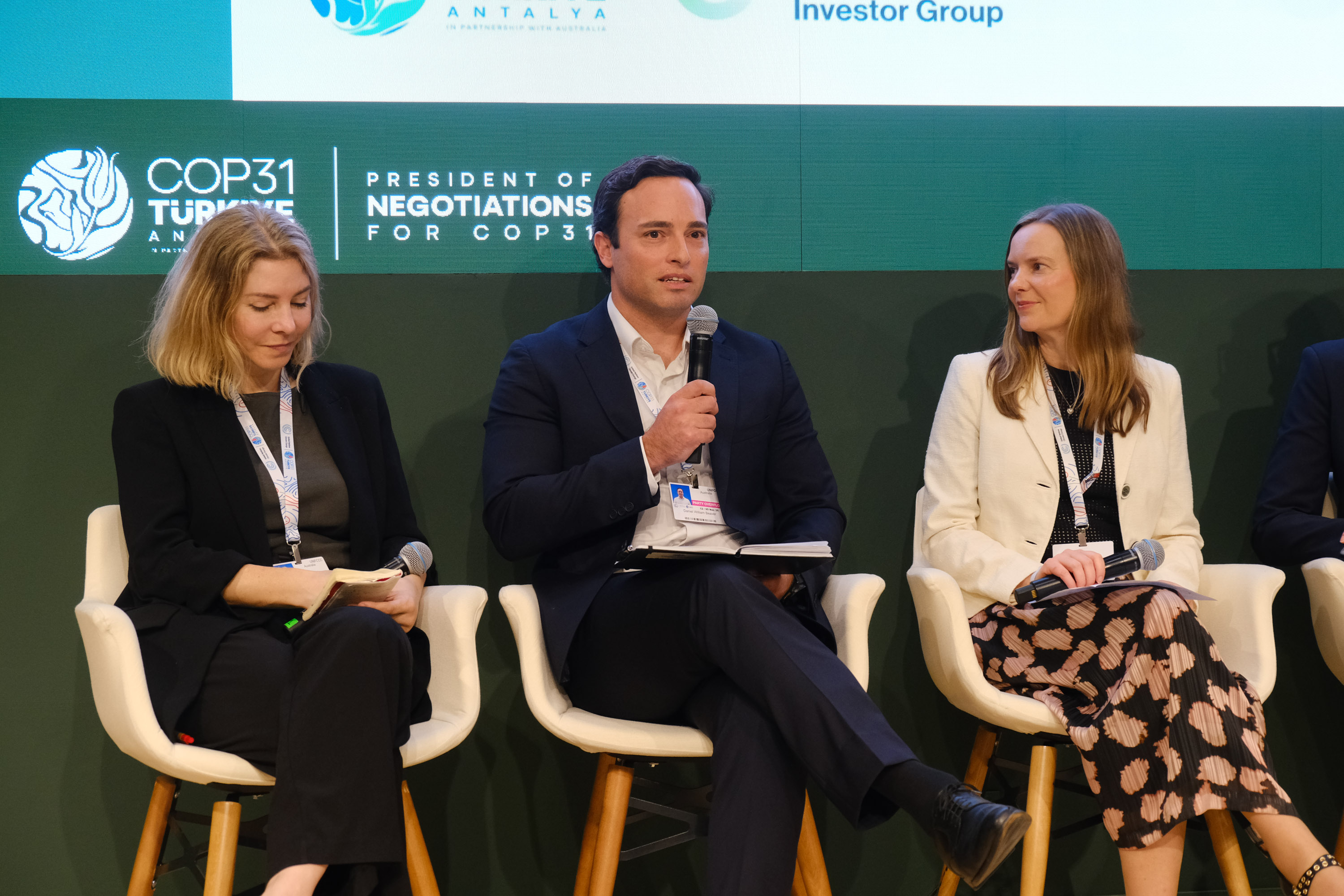
Speaking on a panel at COP31, I highlighted several of the characteristics global infrastructure investors are looking for: structural demand, certainty around long-term cash flows, regulatory predictability, downside protection and the ability to create platforms with the potential to scale.
Governments and private investors can hold different forms of risk. Well-designed public policy, underwriting mechanisms and development capital can help address risks the private market cannot efficiently absorb alone, creating the conditions for substantially greater pools of institutional capital to participate. This is why the transition increasingly needs to be considered not simply as a financing challenge, but as a question of risk allocation and market design.
One of the clearest conclusions in Antalya was the increasingly close relationship between climate investment and energy security. Recent geopolitical and energy-market shocks have changed how governments and investors think about energy infrastructure. Domestic generation, storage, transmission, interconnection and system flexibility do not only contribute to decarbonisation. They can also reduce exposure to imported fuels, increase resilience and support economic competitiveness.
More importantly for investors, resilience is increasingly becoming financially visible. The discussions at COP suggested that physical and energy resilience are starting to feed into the cost of capital and credit, while regulators are increasingly asking networks to demonstrate how resilience is being built into investment plans. That changes the equation: resilience is moving from being principally an engineering consideration to becoming an investment, financing and regulatory one.
This also reflects a broader shift from mitigation alone towards adaptation. As physical climate risks become more visible, the investment requirement is increasingly not only to reduce future emissions, but to ensure today's infrastructure can withstand the climatic and operational pressures already emerging.
That broadens the investment opportunity. The next phase of the energy transition is not only about adding renewable generation. It requires the infrastructure that allows increasingly electrified economies to function reliably: networks, storage, flexible capacity and the wider systems needed to move and manage power.
The growth of digital infrastructure was another recurring topic. AI and data centres are creating potentially significant new sources of electricity demand at the same time as transport, industry and other parts of the economy electrify. For renewable infrastructure investors, this creates opportunity, but also a delivery challenge.
There is a lot of potential for renewable portfolios to support the build-out of data-centre capacity, including opportunities for co-location in regional markets. The timing mismatch between the speed at which new power users want capacity and the time required to build major renewable infrastructure remains a clear issue.
Solving that mismatch requires more than generation alone. Grid access, contracting markets, planning, storage and complementary infrastructure all become part of the investment equation.
Energy infrastructure cannot be developed at the required scale if every project requires an entirely new solution to contracting, financing, planning and delivery. For investors, scalability and repeatability matter because they allow capital to be deployed across platforms rather than individual assets. For governments, they offer the potential to accelerate delivery.
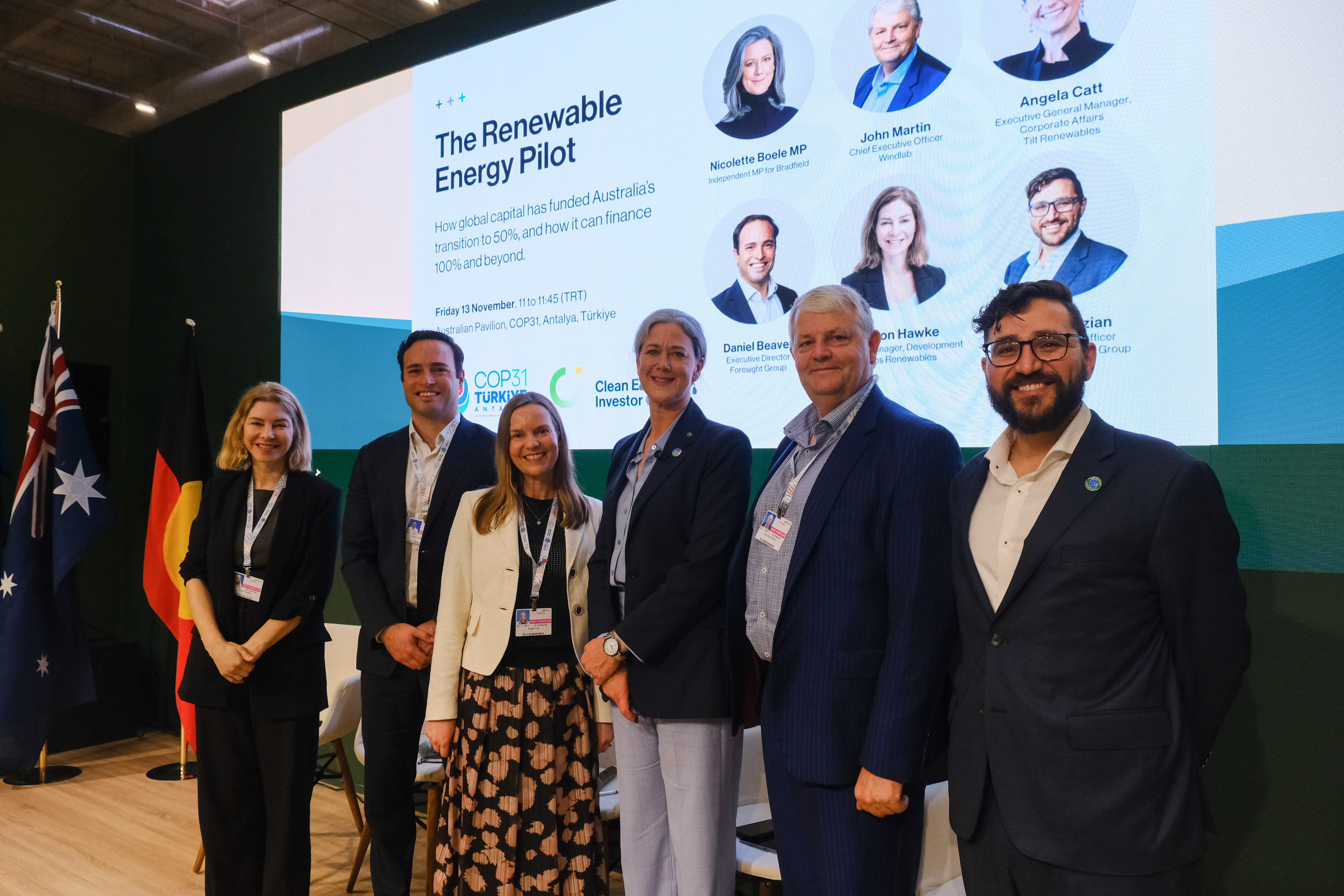
My panel reflected this. Bringing projects through development and into financial close remains too slow in many markets. The objective should not simply be to establish ambitious pipelines, but to create market structures capable of converting those pipelines into operating infrastructure.
For Australia, this is particularly relevant as rising electricity requirements meet the retirement of existing generation and growing demand from electrification and digital infrastructure. Data centres illustrate the challenge particularly clearly. Developers are seeking substantial volumes of reliable power on relatively short timescales, while major new generation and network infrastructure can take considerably longer to develop. Demand may be moving faster than infrastructure can currently be delivered.
For countries with strong renewable resources, the opportunity extends beyond supplying electricity to the grid. COP31 discussions around green iron and steel illustrated how abundant renewable energy can potentially underpin new industrial value chains. Australia is particularly interesting in this respect. Its renewable resources, mineral endowment and proximity to Asian markets create the potential to connect clean electricity with the production and export of lower-carbon industrial materials.
The economic opportunity is therefore bigger than renewable generation in isolation. If countries can combine competitive clean power with the infrastructure, policy and capital required to decarbonise industrial production, the energy transition could increasingly become a source of industrial competitiveness.
Producing lower-carbon materials is only half the equation. Investors also need confidence that demand will exist for products that may initially carry a green premium. Procurement commitments, regulation, carbon pricing and other demand-side mechanisms can therefore play an important role in turning technically viable decarbonisation projects into bankable investment opportunities.
The global nature of the challenge is also an opportunity
Perhaps one of the most useful conclusions from COP31 was that many markets are wrestling with remarkably similar problems.
Let’s not reinvent the wheel. There’s lots of smart minds around the world doing great policy work. Let’s take the best bits and then build on in our home markets to really speed up the transition.





Policy frameworks will necessarily differ between countries, but the underlying challenges are increasingly shared. Investors operating internationally have a useful perspective on what is working across different markets. Engagement between policymakers, asset owners, infrastructure managers and industry can help transfer those lessons more quickly.
The central question coming out of COP31 is therefore less about whether the world has sufficient ambition. It is whether markets can create the conditions to translate that ambition, and the capital seeking to support it, into investable projects and functioning infrastructure. For long-term infrastructure investors, that is where the next phase of the energy transition will be won or lost.


