

Real Assets
We build future energy systems and resilient infrastructure, backing emerging opportunities in technology, land and water.

After an initial wide-ranging conversation, participants then focused on two areas: standardisation and the reporting of real-world outcomes. The key headlines from the roundtable were:
At least in WHEB’s case, impact reports are very popular. They are widely read by clients and consultants as well as NGOs, employees, business partners and peers. Their fundamental purpose is to enable clients and other stakeholders to hold us to account and answer the question, ‘are we doing what we said we would do’? Metrics and case studies that provide evidence that underpin claims of positive impact have become much more common, but further improvements in the robustness and accuracy of this data is still needed. Furthermore, it was suggested that reports should not just seek to justify and explain activity, but also to serve as a mechanism for learning and improvement.
Setting out a clear theory of change (ToC) is now firmly established as a core requirement for impact investments. This may be done at the level of the portfolio overall but will also be evident in each individual investment influencing how ultimate outcomes get reported (see below).
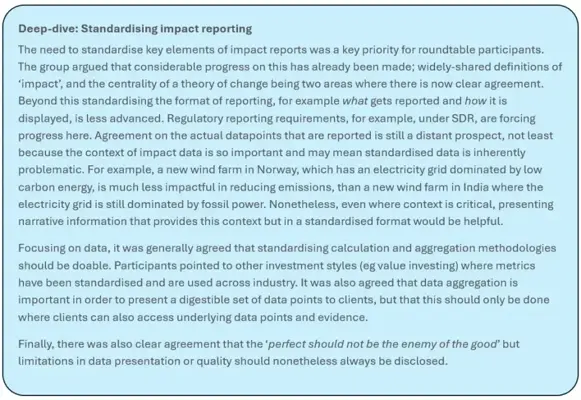
The need to standardise reporting formats and metrics (see below) to add comparability and manage complexity was a high priority among the group and particularly important for advisers and other intermediaries who want to compare performance between different funds. However, standardising while not losing the ability to provide context was seen as a key tension.
As impact reporting has become more popular, so demand for more data has also grown. This is now reaching a point of overload with a need to refocus on relevant – or material – data.
Different audiences have different needs and impact reports on their own will not meet all these needs. Some audiences prefer storytelling and narrative that makes impact investing accessible. Others prefer detailed descriptions of investment processes and metrics that underpin the credibility of the approach and combat greenwashing concerns. The impact report is one element that can support effective communication but needs to be complemented by other communication tools.
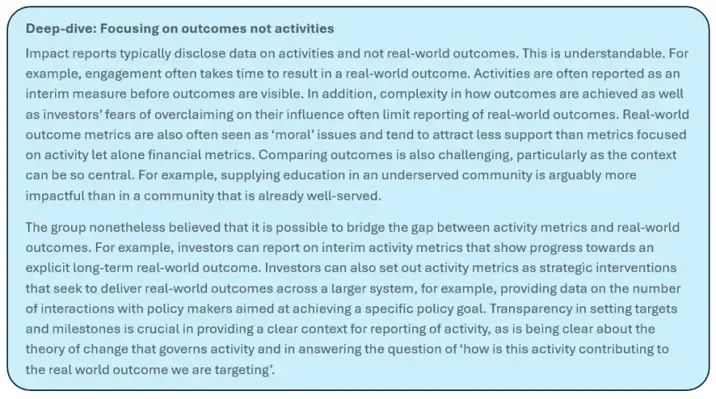
While there was a clear emphasis on standardising reports, one area where more innovation is still needed is in developing effective ways of measuring the real-world outcomes that are associated with impact investments (see below).
With thanks to our roundtable participants:
Archie Cage, Tribe Impact Capital
Bella Landymore, Impact Investing Institute
Conor McQuistin, Net Purpose
Dillon Piggott, East Sussex Pension Fund
Helen Wiggs, ShareAction
Jake Moeller, Square Mile Investment Consulting and Research
Jordan Griffiths, Barnett Waddingham
Matthias Lomas, Guy’s and St Thomas’ Foundation
Paige Nicol, BlueMark
Seb Beloe
Managing Director, FCM & Group Sustainability
Foresight Capital Management


You have viewed 0 of 0
Foresight Group LLP does not offer legal, tax, financial or investment advice and the information on this website should not be construed as such. We recommend investors seek advice from a regulated financial adviser. The opportunity described in this document may not be suitable for all investors. Any such investment decision should be made only on the basis of the Fund scheme documents and appropriate professional advice.
Foresight Group LLP acts as investment manager and is authorised and regulated by the Financial Conduct Authority with Firm Reference Number 198020 and has its registered office at The Shard, 32 London Bridge Street, London SE1 9SG.
OEICs
An investment in FP Sustainable Future Themes Fund, FP Foresight Global Real Infrastructure Fund, FP Sustainable Real Estate Securities Fund, FP UK Infrastructure Income Fund or FP WHEB Sustainability Impact Fund and Liontrust Diversified Real Assets Fund (together the “Funds”) should be considered a long-term investment that may be higher risk. Portfolio holdings are subject to change without notice.
The Authorised Corporate Directors FundRock Partners Limited (registered office at Hamilton Centre, Rodney Way, Chelmsford, England, CM1 3BY) and Liontrust Investment Partners LLP (registered office 2 Savoy Court, London WC2R 0EZ), are authorised and regulated by the Financial Conduct Authority with Firm Reference Numbers 469278 and 518552 respectively. The Funds are incorporated in England and Wales.
ICAVs
An investment in the WHEB Sustainable Impact Fund and the WHEB Environmental Impact Fund (together the “Funds”) should be considered a longer-term investment that may be higher risk. Portfolio holdings are subject to change without notice.
The Manager of the Funds is FundRock Management Company S.A., authorised and regulated by the Luxembourg regulator to act as UCITS management company and has its registered office at Airport Center Building, 5, Heienhaff, L-1736 Senningerberg, Luxembourg.
We respect your privacy and are committed to protecting your personal data. If you would like to find out more about the measures, we take in processing your personal information, please refer to our privacy policy, which can be found at http://www.foresight.group/privacy-policy.


