

Real Assets
We build future energy systems and resilient infrastructure, backing emerging opportunities in technology, land and water.
One in eleven people worldwide goes to bed hungry every night1, and a staggering 29% of the global population experienced moderate or severe food insecurity in 2023.2
There is no single cause of food insecurity. Rather, it stems from a web of interconnected factors, including conflict, climate change, poverty, the loss of farmland, food waste, and the lingering economic effects of the COVID-19 pandemic. As a result, the world is significantly behind in achieving Sustainable Development Goal 2 – Zero Hunger by 2030, making it imperative to find more sustainable solutions.
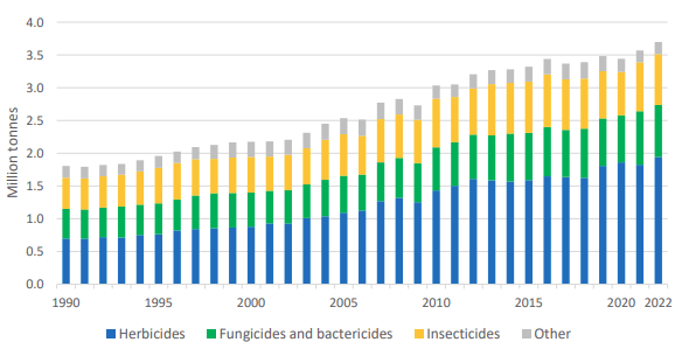
As the global population grows, the need to increase crop yields has led to a significant reliance on pesticides. Historically, pesticides have played a crucial role in protecting crops from pests and diseases, contributing to higher agricultural productivity. From 1990 to 2022, global pesticide use doubled in response to rising food demand.3
Global pesticides use by category4
However, excessive pesticide use has led to diminishing returns. Studies show that over-reliance on chemical pesticides contributes to soil depletion and degradation, water contamination, pest resistance, and biodiversity loss, ultimately threatening long-term yields.5,6 Synthetic nitrogen fertilizers also contribute to global warming by releasing nitrous oxide, a lesser-known greenhouse gas that traps 273 times more heat than carbon dioxide.7 The supply chain for these fertilizers is responsible for more than 10% of global emissions from agriculture.8
According to the Food and Agriculture Organisation, integrated pest management offers a more sustainable approach, combining biological pest control, precision application techniques, and other strategies to minimise pesticide dependency while maintaining high crop yields.9 A thriving ecosystem is essential for resilient food systems, as biodiversity helps buffer against external shocks like climate change. It is clear that pesticides have a role to play, but they must be used more strategically alongside sustainable farming practices.
Recognising the risks associated with pesticides, policymakers are stepping up efforts to curb their use. The European Green Deal aims to reduce both the use and risk of chemical pesticides by 50% by 2030.10 Similarly, the Kunming–Montreal Global Biodiversity Framework, adopted in December 2022 under the UN Convention on Biological Diversity, sets a target to cut the overall risk from pesticides and hazardous chemicals by at least half.11
Some estimates suggest that adopting the European Green Deal targets globally could lead to a 12% reduction in agricultural yields.12 However, this doesn’t tell the whole story. Other policies under the European Green Deal such as reducing food waste, shifting towards plant-based diets, and increasing organic farming can help offset short-term yield reductions while improving long-term food security and ecosystem health.13
To mitigate the drawbacks of excessive pesticide use, we must invest in more sustainable agricultural technologies. Precision farming is one such solution, optimising resource use and improving crop yields through advanced tools like GPS guidance and data-driven decision-making.
One of our portfolio companies, Trimble, specialises in precision agriculture technologies, spanning seeding, fertiliser application, crop protection, and water management. For example, its weed protection system precisely applies herbicide only when a weed is detected by a sensor, potentially reducing herbicide usage by up to 90%.14
Another key innovator in sustainable farming is Croda, which develops solutions that reduce pesticide dependency while maintaining agricultural productivity. Croda’s agricultural adjuvants improve pesticide efficiency by enhancing droplet coverage on plant leaves and minimising spray drift, ensuring that the product reaches its intended target. Additionally, Croda’s advanced seed coating technologies protect seeds from pests and diseases while enhancing germination rates. By applying treatments directly to seeds, farmers can significantly reduce early-stage pesticide use by as much as 95% while maintaining crop health and yield.15
With growing awareness of the risks associated with excessive pesticide use and increasingly stringent environmental regulations, demand for sustainable farming solutions is accelerating. More importantly, economic benefits are driving adoption, as farmers increasingly recognise yield improvements and lower production costs as key incentives.16 This presents a compelling opportunity for our portfolio companies, whose innovative and effective alternatives to traditional pesticides position them well to benefit from this structural shift in agriculture. In addition, the next 12-month P/E multiples of both companies are trading below their five-year averages – with Croda near its five-year low17– presenting, in our view, compelling investment opportunities given the strong long-term demand for their products and services.
Food insecurity isn’t just an abstract global issue. It’s a challenge that affects millions of people every day, which demands a fundamental shift towards more sustainable agricultural practices. As impact investors, we support sustainable solutions that can make a real difference. By investing in innovative technologies like precision farming and advanced seed treatments, we can reduce pesticide reliance while ensuring long-term food security.
Ty Lee
Associate Director, Investments
Foresight Capital Management
Foresight Group LLP does not offer legal, tax, financial or investment advice and the information on this website should not be construed as such. We recommend investors seek advice from a regulated financial adviser. The opportunity described in this document may not be suitable for all investors. Any such investment decision should be made only on the basis of the Fund scheme documents and appropriate professional advice.
Foresight Group LLP acts as investment manager and is authorised and regulated by the Financial Conduct Authority with Firm Reference Number 198020 and has its registered office at The Shard, 32 London Bridge Street, London SE1 9SG.
OEICs
An investment in FP Sustainable Future Themes Fund, FP Foresight Global Real Infrastructure Fund, FP Sustainable Real Estate Securities Fund, FP UK Infrastructure Income Fund or FP WHEB Sustainability Impact Fund and Liontrust Diversified Real Assets Fund (together the “Funds”) should be considered a long-term investment that may be higher risk. Portfolio holdings are subject to change without notice.
The Authorised Corporate Directors FundRock Partners Limited (registered office at Hamilton Centre, Rodney Way, Chelmsford, England, CM1 3BY) and Liontrust Investment Partners LLP (registered office 2 Savoy Court, London WC2R 0EZ), are authorised and regulated by the Financial Conduct Authority with Firm Reference Numbers 469278 and 518552 respectively. The Funds are incorporated in England and Wales.
ICAVs
An investment in the WHEB Sustainable Impact Fund and the WHEB Environmental Impact Fund (together the “Funds”) should be considered a longer-term investment that may be higher risk. Portfolio holdings are subject to change without notice.
The Manager of the Funds is FundRock Management Company S.A., authorised and regulated by the Luxembourg regulator to act as UCITS management company and has its registered office at Airport Center Building, 5, Heienhaff, L-1736 Senningerberg, Luxembourg.
We respect your privacy and are committed to protecting your personal data. If you would like to find out more about the measures, we take in processing your personal information, please refer to our privacy policy, which can be found at http://www.foresight.group/privacy-policy.


